First Impressions
Hi everybody-
I'm 79 pages into Lolita, and even though at times this book is truly disturbing, it's surprisingly addicting to read. When I read the first few pages, I was worried that it would be a slow read, partly because of the extremely rich, descriptive writing Vladimir Nabokov uses, but it's increasingly become a serious page-turner. In this blog, I won't be addressing any of the specific requirements yet (I'm saving those for later posts), but I'm just going to put a few of my thoughts out there about my initial reaction and things I've noticed.
My first topic is best framed as a question, one that I ask with a fairly sizable amount of concern- was Vladimir Nabokov okay? I understand that Lolita is a work of fiction, but one common conclusion that I've drawn from most other fiction books I've read is that there is always a certain amount of truth that can be pulled out of the story, a truth that reflects the author in some way. I am in no way accusing Nabokov of being a pedophile like his main character, Humbert Humbert, but I can't help but wonder how he writes from the point of view of one with so much intricacy and specificity. I've done some research, and although there are some that suspect he may have had closeted pedophilic tendencies, Nabokov never did anything illegal or even creepy. With this in mind, I think it may just be his extremely impressive talent as a writer that led me to ask this question.
As I mentioned earlier and will address in a later blog, I think Nabokov's convincing storytelling can be attributed to his extremely descriptive and detail-oriented writing style, one that looks through the eyes of Humbert and focuses on the smallest things that most wouldn't even glance at. Humbert notices everything about Lolita, from the way she walks ("A faint suggestion of turned in toes" and "A kind of wiggly looseness below the knee") to the "five asymmetrical freckles of her bobbed nose." I won't get into the intricate fantasies that Humbert conjures up in his head quite yet, but I will say it takes a truly gifted writer to take on the twisted mindset of a perverted character, and Nabokov pulls it off.

Delving into Humbert's character has been very interesting so far. He is a complex character, conscious of how his perverted desires are wrong, but also can't help but string together beautiful sentences about his passion for little Lolita and his appreciation for her "nymphet"-like behaviors. (For those who aren't reading Lolita, Humbert uses the word "nymphet" to describe little girls that are especially attractive and special to him.) He describes his feelings toward her as a "darkness of passion" and "fatal lust." He knows what he is feeling is wrong. Yet, he can't help but feel this way, with emotions so intense that he can't bear them sometimes. If his fondness wasn't being directed toward a 12 year-old girl, this would be a fantastic love story to read, considering the intense romantic feelings Humbert experiences.
The other interesting thing about Humbert is his intelligence, which is crystal-clear. Earlier in the book, he mentions studying psychiatry, and every now and then his knowledge of the field shines through. This book (framed as Humbert's journal) is supposedly being read by a man who is editing the writing to give to a lawyer, after Humbert has been convicted for his crimes. Humbert frequently addresses that someone else may be reading it, and describes making up events to satisfy a psychologist that he speaks to. The way the book is written almost perfectly addresses everything a psychoanalytic therapist would want to hear, considering the event in Humbert's childhood (a relationship with a young lover who passed away shortly after) connects directly to his feelings of desire toward little girls later on. It's almost as if he is trying to return to his past and find a lover just like the one he fooled around with when he was an adolescent boy. Humbert seems to be somewhat aware of the reasoning for his pedophilia, and feels shame for it, but simply cannot stop himself from fawning over Lolita. He also frequently uses humor to tell his stories, and it's conflicting for me as a reader, since he is funny and somewhat likable, but I also have an inside perspective at his twisted inner thoughts.
One question that I have about the writing style is Humbert's use of the third person to describe himself. In the middle of paragraphs he will switch from first person and writing about his inner feelings to third person, switching to a more objective point of few. This switch is extremely brief, however, sometimes only for one sentence, and he quickly goes back to first person. I wonder if it's some sort of coping mechanism for his shame, maybe? It might be a way for Humbert to disconnect from himself and briefly observe his behavior from an outside perspective. I'm interested to see where this goes as his character is developed more.
So far, Lolita is a fascinating read. I'm excited to read more and see what Humbert will do next in order to get closer to Lolita. (For those who aren't reading the book, he is currently married to the little girl's mother just so he can get closer to her and have an excuse to be intimate.) As much as I don't want to, I'm finding myself start to like Humbert. However, I do NOT support his feelings towards Lolita. I really like her character too, and something tells me that she won't be as easy to take advantage of as Humbert thinks she'll be.
I'm 79 pages into Lolita, and even though at times this book is truly disturbing, it's surprisingly addicting to read. When I read the first few pages, I was worried that it would be a slow read, partly because of the extremely rich, descriptive writing Vladimir Nabokov uses, but it's increasingly become a serious page-turner. In this blog, I won't be addressing any of the specific requirements yet (I'm saving those for later posts), but I'm just going to put a few of my thoughts out there about my initial reaction and things I've noticed.
My first topic is best framed as a question, one that I ask with a fairly sizable amount of concern- was Vladimir Nabokov okay? I understand that Lolita is a work of fiction, but one common conclusion that I've drawn from most other fiction books I've read is that there is always a certain amount of truth that can be pulled out of the story, a truth that reflects the author in some way. I am in no way accusing Nabokov of being a pedophile like his main character, Humbert Humbert, but I can't help but wonder how he writes from the point of view of one with so much intricacy and specificity. I've done some research, and although there are some that suspect he may have had closeted pedophilic tendencies, Nabokov never did anything illegal or even creepy. With this in mind, I think it may just be his extremely impressive talent as a writer that led me to ask this question.
As I mentioned earlier and will address in a later blog, I think Nabokov's convincing storytelling can be attributed to his extremely descriptive and detail-oriented writing style, one that looks through the eyes of Humbert and focuses on the smallest things that most wouldn't even glance at. Humbert notices everything about Lolita, from the way she walks ("A faint suggestion of turned in toes" and "A kind of wiggly looseness below the knee") to the "five asymmetrical freckles of her bobbed nose." I won't get into the intricate fantasies that Humbert conjures up in his head quite yet, but I will say it takes a truly gifted writer to take on the twisted mindset of a perverted character, and Nabokov pulls it off.
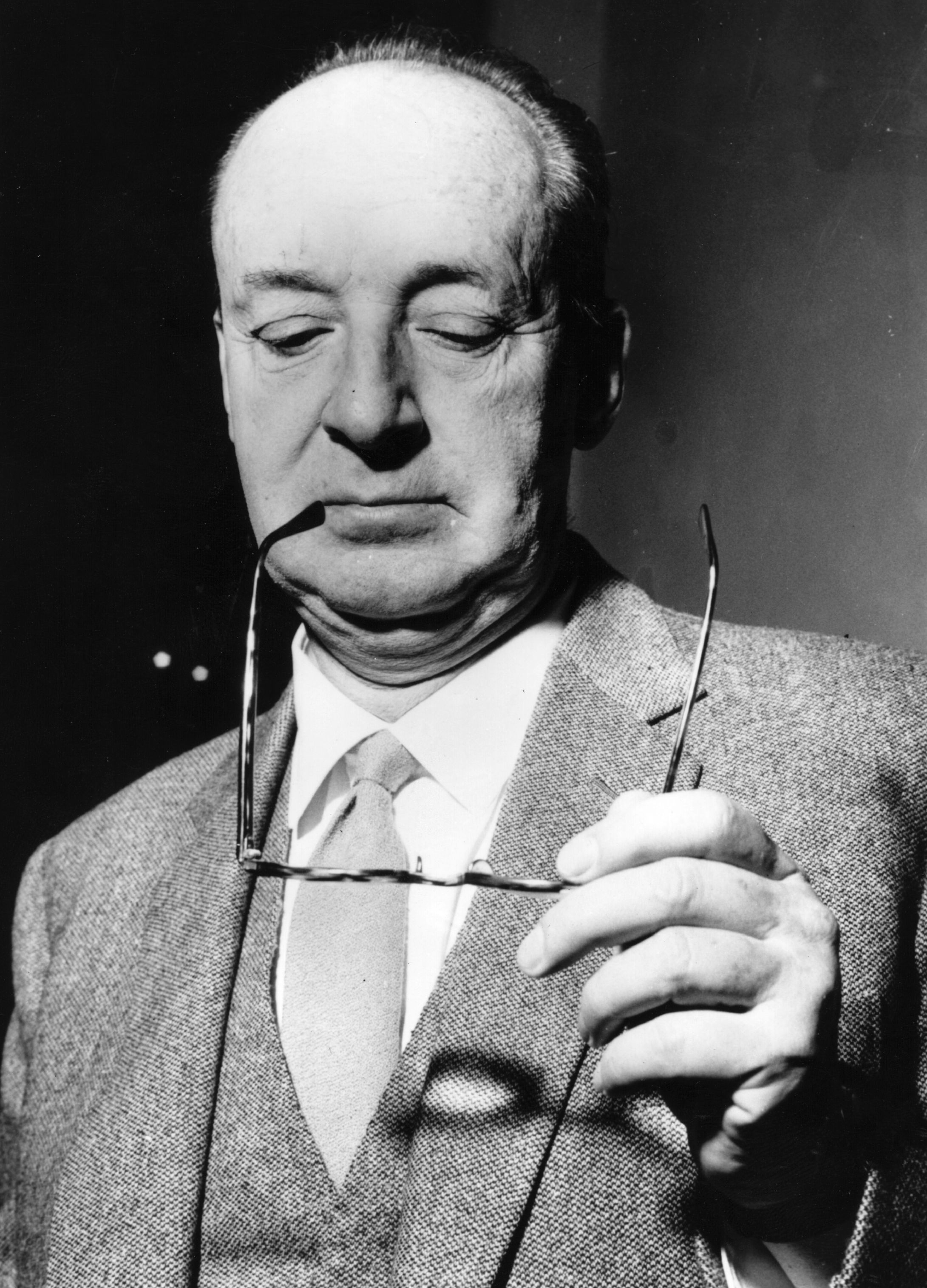
Vladimir Nabokov
The other interesting thing about Humbert is his intelligence, which is crystal-clear. Earlier in the book, he mentions studying psychiatry, and every now and then his knowledge of the field shines through. This book (framed as Humbert's journal) is supposedly being read by a man who is editing the writing to give to a lawyer, after Humbert has been convicted for his crimes. Humbert frequently addresses that someone else may be reading it, and describes making up events to satisfy a psychologist that he speaks to. The way the book is written almost perfectly addresses everything a psychoanalytic therapist would want to hear, considering the event in Humbert's childhood (a relationship with a young lover who passed away shortly after) connects directly to his feelings of desire toward little girls later on. It's almost as if he is trying to return to his past and find a lover just like the one he fooled around with when he was an adolescent boy. Humbert seems to be somewhat aware of the reasoning for his pedophilia, and feels shame for it, but simply cannot stop himself from fawning over Lolita. He also frequently uses humor to tell his stories, and it's conflicting for me as a reader, since he is funny and somewhat likable, but I also have an inside perspective at his twisted inner thoughts.
One question that I have about the writing style is Humbert's use of the third person to describe himself. In the middle of paragraphs he will switch from first person and writing about his inner feelings to third person, switching to a more objective point of few. This switch is extremely brief, however, sometimes only for one sentence, and he quickly goes back to first person. I wonder if it's some sort of coping mechanism for his shame, maybe? It might be a way for Humbert to disconnect from himself and briefly observe his behavior from an outside perspective. I'm interested to see where this goes as his character is developed more.
So far, Lolita is a fascinating read. I'm excited to read more and see what Humbert will do next in order to get closer to Lolita. (For those who aren't reading the book, he is currently married to the little girl's mother just so he can get closer to her and have an excuse to be intimate.) As much as I don't want to, I'm finding myself start to like Humbert. However, I do NOT support his feelings towards Lolita. I really like her character too, and something tells me that she won't be as easy to take advantage of as Humbert thinks she'll be.

Hi Megan! I confess that while I'm not reading it for this project, "Lolita" (I'm not technologically savvy enough to figure out italics) has been on my reading list for quite a while now. Your post, especially the first couple of paragraphs, made it easy for me to understand the material without having read it myself, and I'm excited to learn more about this disturbing novel. I thought your discussion of the author was very interesting, and I can't help but wonder if he himself was ever a student of psychology. Perhaps that would explain Humbert's intelligence and knowledge of the human psyche. I also enjoyed reading briefly about the writing style. The quick transitions between perspectives almost reminds me of the one sentence paragraphs Margaret Atwood sometimes used in "The Handmaid's Tale." I look forward to your next post.
ReplyDeleteHi Clara-
DeleteThanks for reading my blog! Just to quickly address your comment about Humbert's knowledge of the human psyche, he does mention studying psychiatry at some point in the book, so I'm sure he has a deep understanding of mental conditions and what can bring them about (which is partly why he knows EXACTLY what to say to get the reader to understand him and sympathize with him.)
Great points about the shift in narration to the third person, as it is an interesting why that he views himself and his own experiences. I do think it reflects some of his sociopathic tendencies. I like your use of questions to frame your thinking about what you've read.
ReplyDeleteHey Megan! Nice job on this post! I think we had very similar ideas while reading this section, particularly about suspicions regarding Nabokov and the third-person shift. I've done a bit of research on the author and found that we were not the only ones--people have done case studies trying to answer the same question. Pretty much everything I found was fairly inconclusive, but I still have my suspicions. I also think you're right about Humbert's third person references to himself. They're probably one of the ways in which he carefully shifts responsibility, especially considering that this is kind of a persuasive novel in which he does not confess to truly being responsible for very much. It might also just be one of the ways he dissociates himself from a crime he knows is wrong, like how you described it as a coping mechanism. I can't wait to talk about the second quarter with you!
ReplyDelete